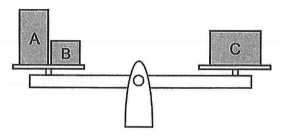
The figure shows three boxes A, B and C on a balance scale. The average mass of the three boxes is 240 g. The mass of B is a 2-digit number. What is the smallest possible difference between the mass of A and B? (3 marks)
Answer: 162 g
Workings
Average mass of 3 boxes = 240 g
Total mass of 3 boxes
= 240 × 3
= 720 g
From the balance scale, A + B = C.
So C is half of the total mass.
C
= 720 ÷ 2
= 360 g
A + B = 360 g
To make the difference between A and B as small as possible, B must be as large as possible.
B is a 2-digit number, so the largest possible value of B is 99 g.
A
= 360 - 99
= 261 g
Difference between A and B
= 261 - 99
= 162 g
162
Loading drawing…
Loading drawing…
"The average mass of the three boxes is 240 g."
total mass = 240 x 3 = 720g
from the picture, A and B is equal to C
which means...
A+B = 720 ÷ 2 = 360g
"What is the smallest possible difference between the mass of A and B?"
"The mass of B is a 2-digit number. "
that means we need B to be the largest 2 digit number, because we want the smallest difference
B → 99g
A → 360 - 99 = 261g
smallest possible difference
→ A - B
= 261 - 99 = 162g
Video explanations
1 video