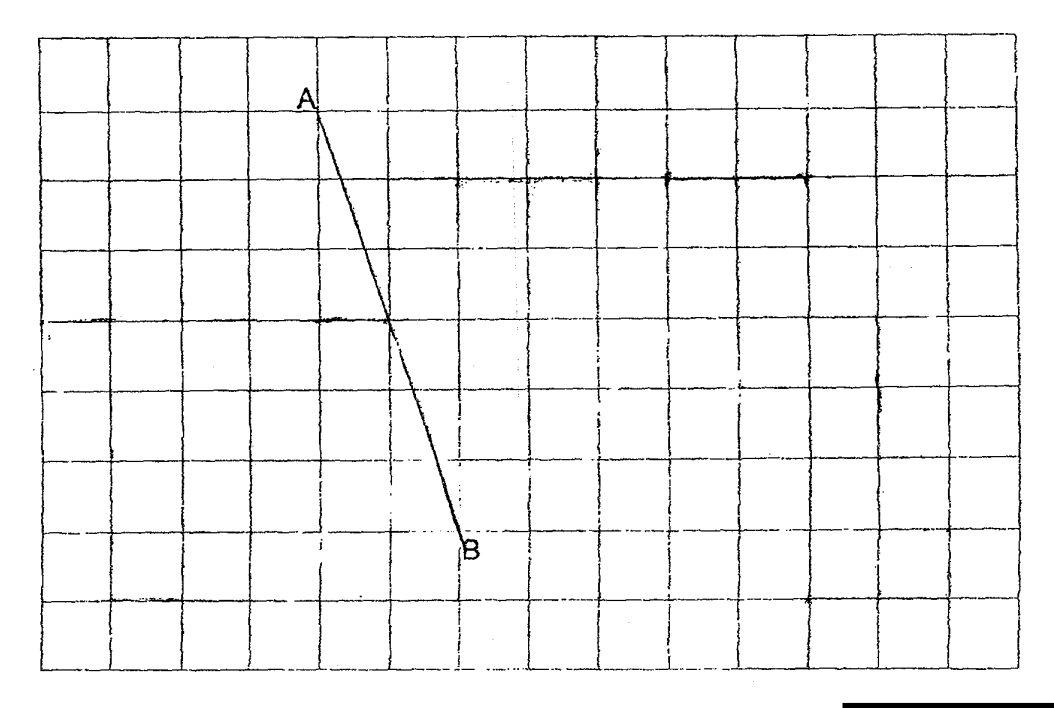
Independent solution, checked against the source construction. From A to B the given side goes 2 squares right and 6 down. Half this length is represented by a displacement of 1 right and 3 down. For BC take a perpendicular displacement of the same length: 3 right and 1 up from B. Place C there. From C move 1 left and 3 up to D, then join D to A.
This makes CD parallel to AB and half its length. BC has the same length as CD and is perpendicular to AB, so ∠ABC is 90°. With the top-left grid intersection as (0, 0), counting right and down, the vertices are A(4, 1), B(6, 7), C(9, 6), D(8, 3). These coordinates are a check on the construction, not an automatic numeric key.