(i) ∠QVW = 180° − 50° − 38° = 92°. Vertically opposite angles give ∠RVU = 92°, equal to ∠SPW.
(ii) ∠PWQ = 180° − 50° = 130°. ∠PQW = 180° − 130° − 21° = 29°. Therefore ∠PQV = 29° + 38° = 67°, equal to ∠QTU. The source concludes TU is parallel to QV.
PQRS is a parallelogram, and PQT and PVU are straight lines. ∠QWV = 50°, ∠WQV = 38°, ∠WSR = 29°, ∠QPW = 21° and ∠QTU = 67°. (b) Each statement is either true, false or not possible to tell. Put a tick (✓) to indicate your answer. ∠SPW = ∠RVU. TU is parallel to QV. (2 marks)
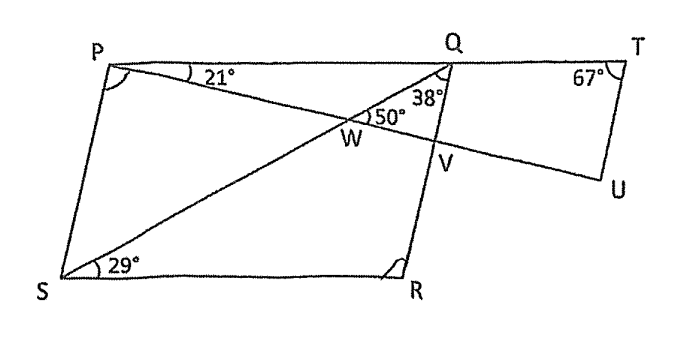
(i) ∠QVW = 180° − 50° − 38° = 92°. Vertically opposite angles give ∠RVU = 92°, equal to ∠SPW.
(ii) ∠PWQ = 180° − 50° = 130°. ∠PQW = 180° − 130° − 21° = 29°. Therefore ∠PQV = 29° + 38° = 67°, equal to ∠QTU. The source concludes TU is parallel to QV.