Solution
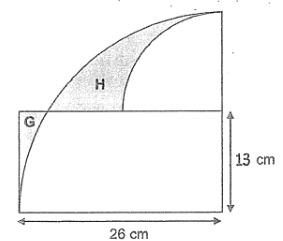
Let A be the overlap used in both shaded-area expressions, as shown in the diagram.
Area of G → rectangle − A
For H, the large quadrant is made up of H, A and the small quadrant.
Area of H → large quadrant − A − small quadrant
Difference, H − G → (large quadrant − A − small quadrant) − (rectangle − A)
The A terms cancel.
So, H − G → large quadrant − small quadrant − rectangle
Area of large quadrant → 1/4 × 3.14 × 26 × 26 = 530.66 cm²
Area of small quadrant → 1/4 × 3.14 × 13 × 13 = 132.665 cm²
Area of rectangle → 26 × 13 = 338 cm²
Difference → 530.66 − 132.665 − 338 = 59.995 cm²
Answer: 59.995 cm²