Independently corrected explanation.
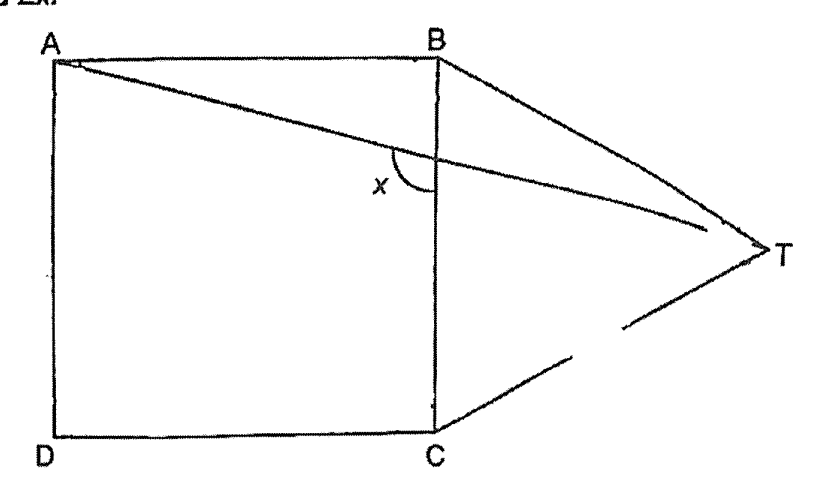
Let P be the intersection of AT and BC. Since ABCD is a square and BCT is equilateral, AB = BC = BT. Thus triangle ABT is isosceles.
∠ABT = 90° + 60° = 150°. Hence ∠BAT = (180° − 150°) ÷ 2 = 15°.
In triangle ABP, ∠APB = 180° − 90° − 15° = 75°. The marked angle x is adjacent to this angle on the straight line BC, so x = 180° − 75° = 105°.
This uses a newly defined point P, not the nonexistent E label in the supplied workings.