Learn this concept that can help score AL1 in Math PSLE (Constant Difference)
 By Haris Samingan
Ratio questions can become challenging when they involve changes over time, but there's a powerful concept that makes these problems much easier: Constant Difference. This concept applies when the difference between two quantities stays the same even as the ratio changes.
How to Spot a "Constant Difference" Question
Look for these key indicators:
- A "Before" and "After" scenario - Two different time periods or states
- Both quantities change by the same amount - Equal additions or time passing
- The difference remains constant - The gap between the two quantities doesn't change
Common situations include:
- Age problems where time passes equally for everyone
- Adding the same amount to both quantities
- Simultaneous growth at the same rate
Example Question
Let's look at a typical PSLE-style age problem:
The ages of Mia and Lucas are in the ratio of 4:7. In 6 years' time, their ages will be in the ratio of 3:5. How old is Lucas now?
Can you spot the constant difference?
- Before: Ages are in ratio 4:7
- Change: Both age by 6 years (same change!)
- After: Ages are in ratio 3:5
Since both Mia and Lucas age by the same 6 years, the difference between their ages stays constant. This is the key insight!
The Solution Method
Step 1: Create the Before-Change-After Table
Set up a table with an additional column for "Difference":
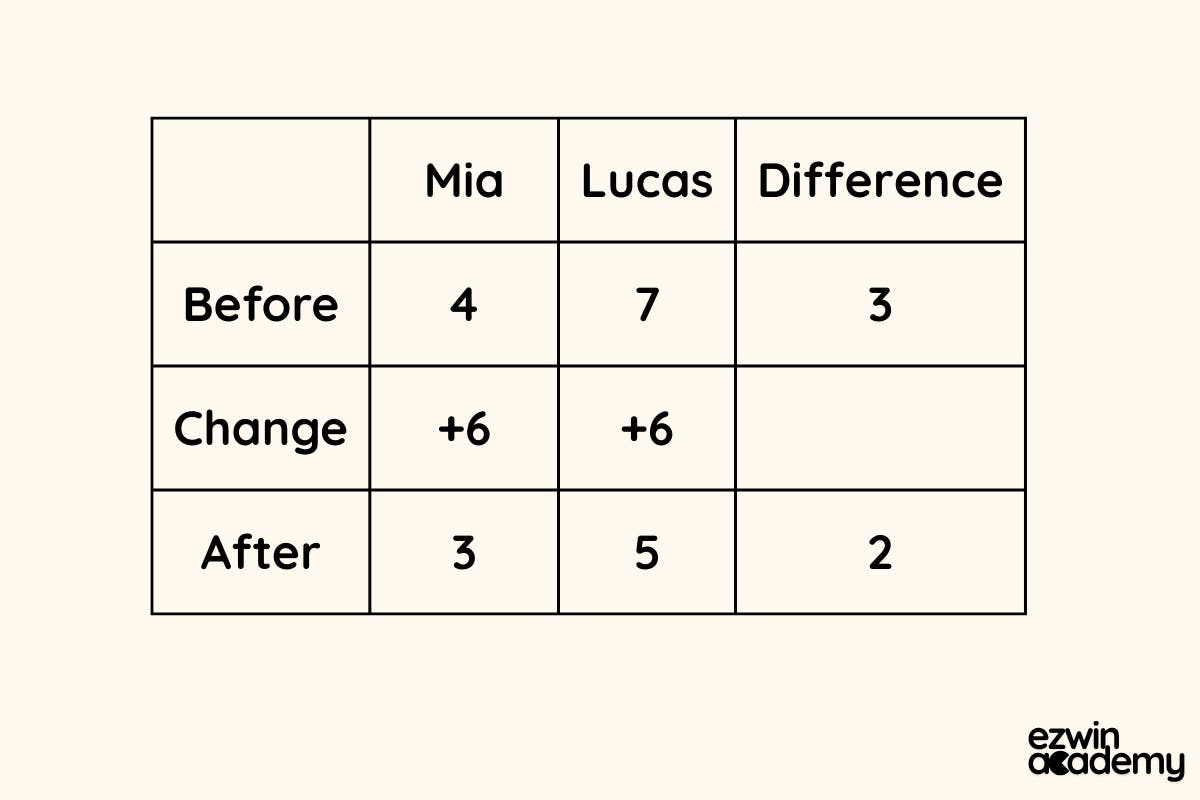
Notice: The difference in the "Before" state is 7 - 4 = 3, and in the "After" state is 5 - 3 = 2. But these are in ratio form, not actual values!
Step 2: Find the Lowest Common Multiple
Since the difference has no change as they age (both add 6 years), we need to find the lowest common multiple (LCM) of the two difference ratios: 3 and 2.
LCM of 3 and 2 = 6
This tells us that 1 unit of difference = 6 years in reality.
Step 3: Change the Ratios
To make the differences equal to 6, we need to multiply each ratio:
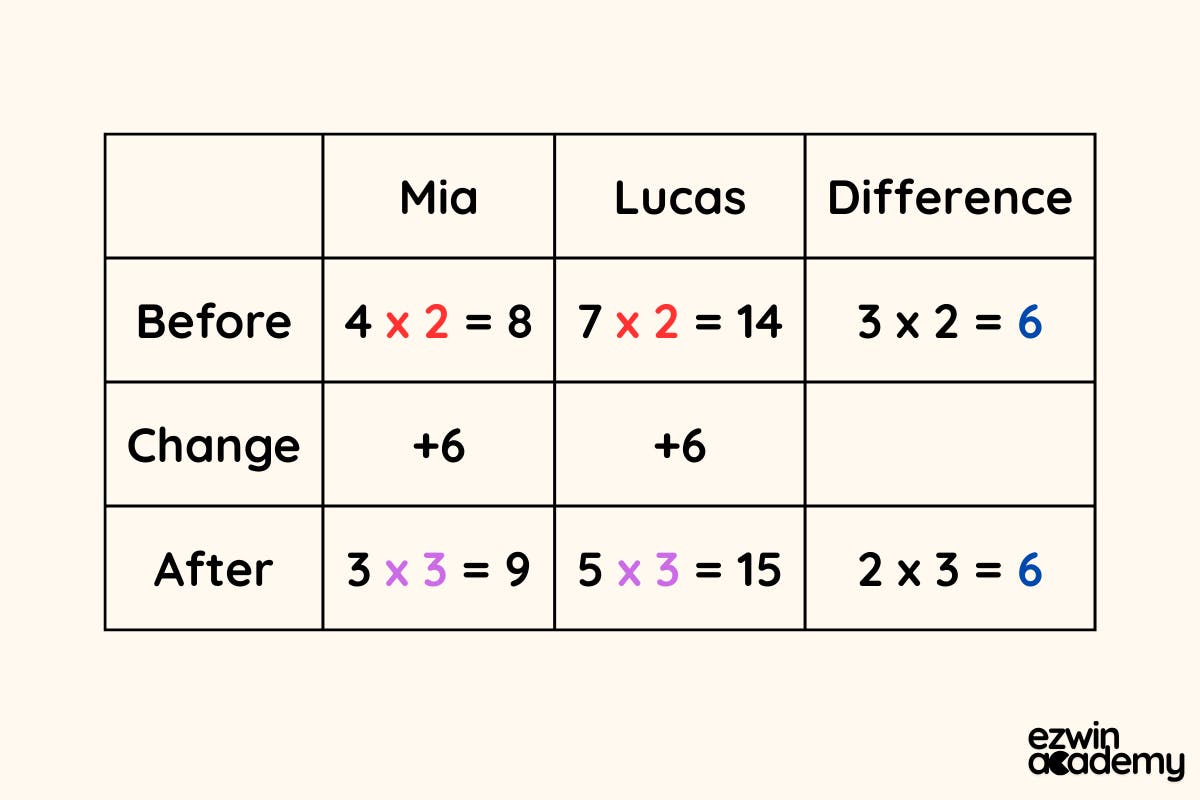
Before ratio (difference = 3):
- Multiply by 2: Mia = 4 × 2 = 8, Lucas = 7 × 2 = 14
- New difference = 3 × 2 = 6 ✓
After ratio (difference = 2):
- Multiply by 3: Mia = 3 × 3 = 9, Lucas = 5 × 3 = 15
- New difference = 2 × 3 = 6 ✓
Step 4: Find the Difference in Units
Now we can see the actual change:
- Lucas: 15 - 14 = 1u
- Change = 6 years
- Therefore: 1u = 6 years
Step 5: Solve for the Answer
The question asks: How old is Lucas now?
From our table, we can see that in 6 years' time (the "After" state), Lucas will be 15 units.
Since 1u = 6 (from our LCM calculation representing the age difference):
- Lucas in 6 years = 15u = 15 × 6 = 90 years old
But we need Lucas's age NOW, not in 6 years:
- Lucas now = 90 - 6 = 84 years old
Alternatively, we can calculate directly from the "Before" state:
- Lucas now = 14 (from the adjusted ratio where the difference equals 6)
- But this 14 is not in units; we need to figure out the actual age
Why This Concept Matters
The "Constant Difference" concept is an advanced problem-solving strategy not found in the official syllabus. It:
- Simplifies complex age and ratio problems
- Uses the LCM technique to make difference equal
- Appears frequently in PSLE Math Paper 2
- Is essential for tackling Difficulty 4 and 5 questions
Key Takeaway
When you see a ratio question where:
- There's a "Before" and "After" state
- Both quantities increase by the same amount
- You have two different ratios
Use the "Constant Difference" concept. Find the LCM of the differences, adjust the ratios accordingly, and solve systematically. This structured approach makes challenging ratio problems much more manageable!
Mastering the "Constant Difference" concept is what helps students tackle difficult ratio questions with confidence in PSLE Math!