Learn this concept that can help score AL1 in Math PSLE (Grouping)
 By Haris Samingan
How would you solve this question:
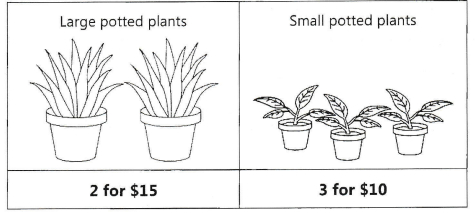
Peiyi and Jamal bought potted plants at the prices shown below. Peiyi bought an equal number of large and small potted plants. She spent $175 more on the large ones. How many potted plants did she buy altogether?
Well, you probably can guess from the title. We can solve it using Simultaneous Equation
What is a Grouping Concept Question?
A Grouping concept question is a type of word problem where items are sold in sets or bundles, and you need to compare quantities or spending.
For example:
- Large plants: 2 for $15
- Small plants: 3 for $10
There are two types of grouping problems:
Type 1: Equal number of items - You buy the same number of items e.g large and small plants
Type 2: Equal money spent - You spend the same amount on items e.g. small tub and big tub ice-cream
The key idea is to create groups using the Lowest Common Multiple (LCM), and if the question has a difference, we can use the difference to solve the problem.
How to Spot a Grouping Concept Question
You can tell it's a Grouping concept question when you see:
- Items sold in bundles or sets (2 for $15, 3 for $10)
- Either: Equal numbers of different items ("equal number of X and Y item"), OR Equal money spent on different items ("spent the same amount on X and Y item")
Important: Check carefully whether the problem says "equal number" or "same amount of money" - this changes how you solve it!
Example Question 1: Equal Number of Items
Problem: Peiyi and Jamal bought potted plants at the prices shown below. Peiyi bought an equal number of large and small potted plants. She spent $175 more on the large ones. How many potted plants did she buy altogether?
Prices:
- Large plants: 2 for $15
- Small plants: 3 for $10
How to Solve Them
Type 1: Equal Number of Items
Follow these steps when the problem says "equal number":
Step 1: Find the Lowest Common Multiple (LCM)
Find the LCM of the bundle sizes to create equal quantities.
Bundle sizes: 2 (large) and 3 (small)
LCM of 2 and 3 = 6
This means we need 6 large plants and 6 small plants to have equal numbers.
Step 2: Calculate the Cost for Equal Quantities
Find how much it costs to buy the LCM quantity of each type.
For large plants:
- 2 large plants cost $15
- 6 large plants = 15 × 3 = $45
For small plants:
- 3 small plants cost $10
- 6 small plants = 10 × 2 = $20
Step 3: Find One Group
One group has equal numbers of both types of plants.
1 group = 6 large + 6 small = 12 potted plants
Step 4: Find the Difference Per Group
Calculate how much more is spent on large plants per group.
1 group difference = $45 - $20 = $25
This means for every group of 12 plants, Peiyi spends $25 more on the large ones.
Step 5: Find the Number of Groups
Divide the total difference by the difference per group.
Number of groups = 175 ÷ 25 = 7 groups
Step 6: Calculate the Total
Multiply the number of groups by the plants per group.
Total potted plants = 12 × 7 = 84 plants
Check Your Answer
Let's verify:
- 7 groups means 7 × 6 = 42 large plants and 42 small plants ✓ (equal numbers)
- Large plants cost: 42 ÷ 2 = 21 bundles, 21 × $15 = $315
- Small plants cost: 42 ÷ 3 = 14 bundles, 14 × $10 = $140
- Difference: $315 - $140 = $175 ✓
Example Question 2: Equal Money Spent
Problem: Peiyi and Jamal bought potted plants at the prices shown below. Peiyi spent the same amount of money on large and small potted plants. She bought 39 more small plants than large plants. How many potted plants did she buy altogether?
Prices:
- Large plants: 3 for $5
- Small plants: 5 for $4
Type 2: Equal Money Spent
Follow these steps when the problem says "same amount of money":
Step 1: Find the LCM of the Prices
Find the LCM of the prices (not the bundle sizes!) to find equal spending.
Prices: $5 (for large) and $4 (for small)
LCM of 5 and 4 = 20
This means we spend $20 on each type to compare fairly.
Step 2: Calculate the Quantity for Equal Spending
Find how many items you get for the LCM amount.
For large plants:
- $5 → 3 large plants
- $20 → 20 ÷ 5 = 4 sets, so 3 × 4 = 12 large plants
For small plants:
- $4 → 5 small plants
- $20 → 20 ÷ 4 = 5 sets, so 5 × 5 = 25 small plants
Step 3: Find One Group
One group has the quantities you get for equal spending.
1 group = 12 large + 25 small = 37 potted plants
Step 4: Find the Difference Per Group
Calculate the difference in number of plants per group.
1 group difference = 25 - 12 = 13 plants
This means for every $20 spent on each type, there are 13 more small plants than large plants.
Step 5: Find the Number of Groups
Divide the total difference by the difference per group.
Number of groups = 39 ÷ 13 = 3 groups
Step 6: Calculate the Total
Multiply the number of groups by the plants per group.
Total potted plants = 37 × 3 = 111 plants
Or calculate separately:
- Large plants: 12 × 3 = 36
- Small plants: 25 × 3 = 75
- Total: 36 + 75 = 111 plants
Double Check Your Answer
Let's verify:
- Large plants: 36 ÷ 3 = 12 bundles, 12 × $5 = $60 spent
- Small plants: 75 ÷ 5 = 15 bundles, 15 × $4 = $60 spent ✓ (equal spending)
- Difference: 75 - 36 = 39 more small plants ✓