Learn this concept that can help score AL1 in Math PSLE (Everything Changed)
 By Haris Samingan
Ratio questions can become surprisingly difficult when combined with other topics, especially when changes happen to both quantities. That's where the "Everything Changed" concept comes in—a powerful heuristic that helps students solve these tricky problems systematically.
How to Spot an "Everything Changed" Question
Look for these three key things:
- A "Before" - The beginning ratio
- A change happens - Both quantities change (items are added or removed)
- An "After" - The final ratio after the change
If you see all three things, and both quantities in the ratio have changed, you're dealing with an "Everything Changed" question.
Example Question
Let's look at a typical PSLE-style question:
Lucy had an equal number of gold stars and silver stars. She gave 26 gold stars and 14 silver stars to Maggie. She gave the remaining stars to Nick. Nick was given 1 gold star for every 3 silver stars.
Can you spot the three elements?
- Before: Equal number of gold and silver stars (ratio 1:1)
- Change: Gave away 26 gold stars and 14 silver stars
- After : Remaining stars in ratio 1:3 (what Nick received)
Take note: this is one of the hardest question as students need to understand the "after" is Nicks situation.
Both quantities changed (both gold AND silver stars were given away), so this is an "Everything Changed" question.
The Solution Method
Step 1: Create a Before-Change-After Table
Set up a clear table to organise the information:
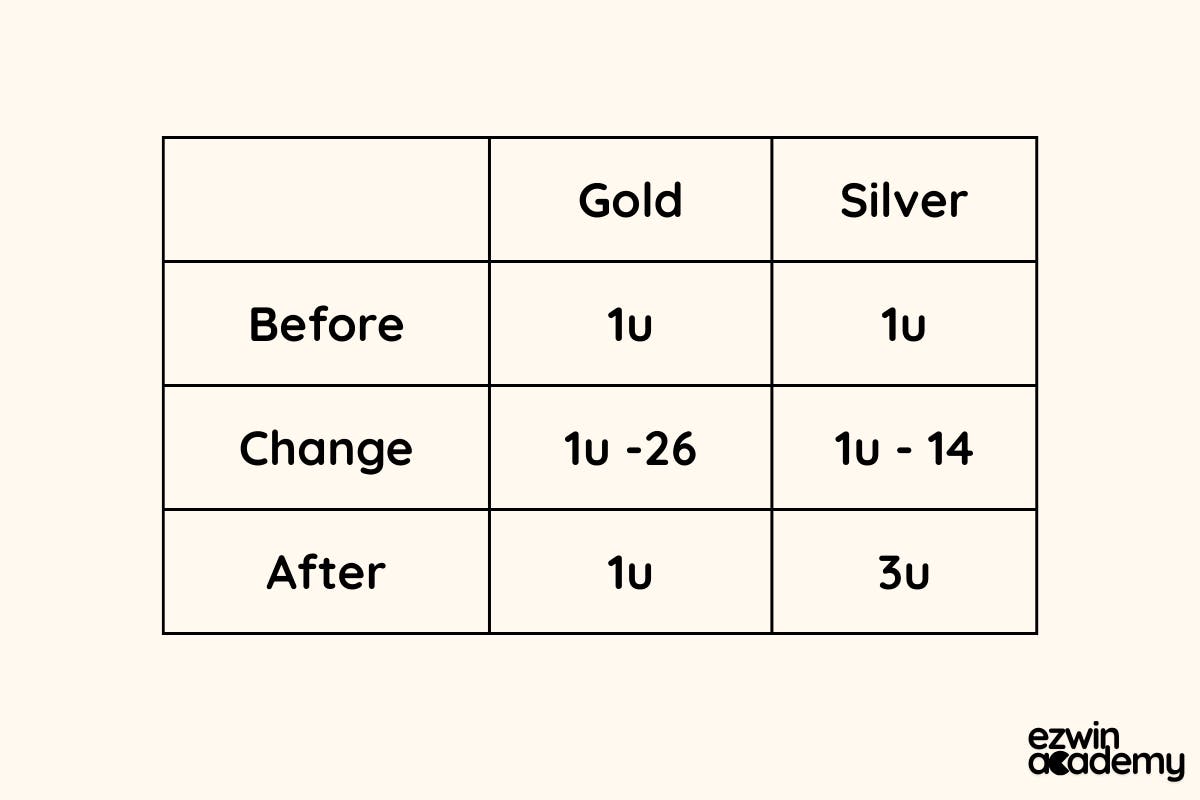
Gold : Silver
- Before: 1u : 1u (equal number)
- Change: 1u -26 : 1u - 14 (gave away)
- After: 1u : 3u (Nick's ratio)
This visual representation makes it easier to see what's happening at each stage.
Step 2: Use the "Everything Changed" Formula
The key insight is that when everything changes, the change in each quantity must maintain the final ratio relationship.
From our table:
- Change: 1u - 26 : 1u - 14
- After: 1u : 3u
Since the "After" values must be in the ratio 1:3, we cross multiply:
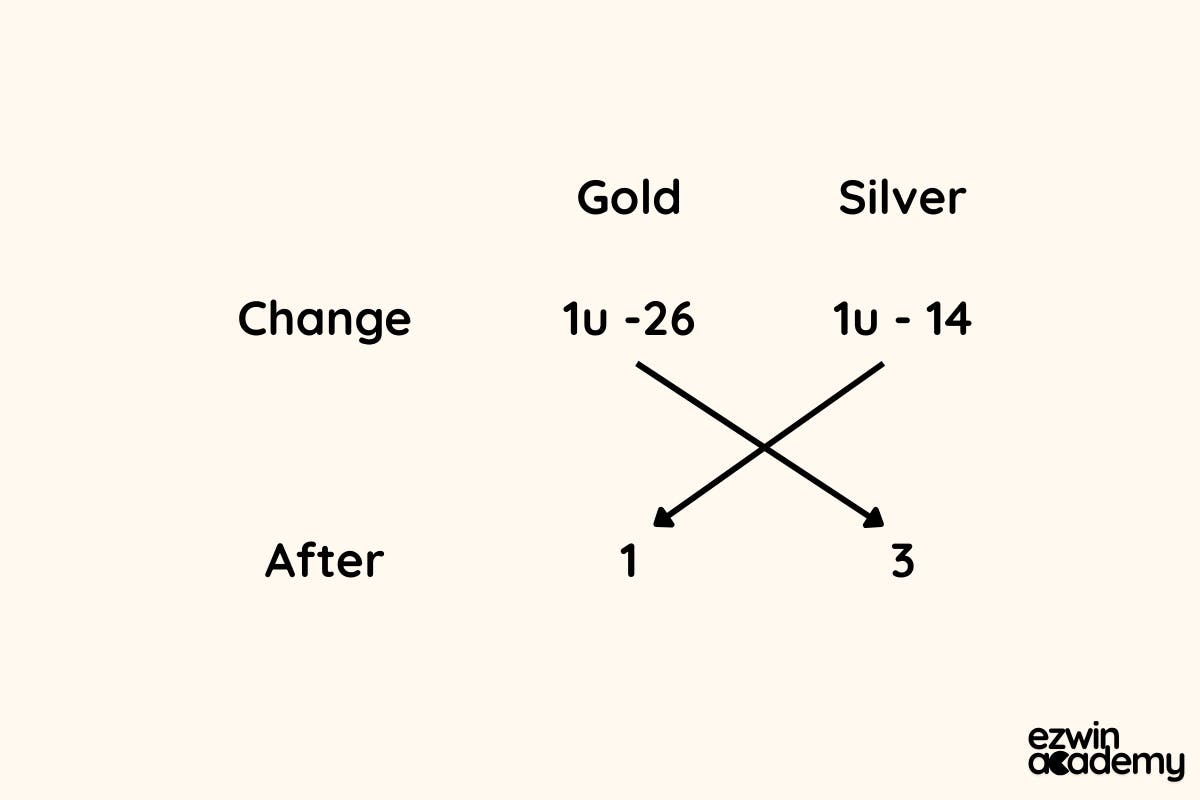
1u - 14 = 3 × (1u - 26)
This equation captures the relationship between the changes and the final ratio.
Step 3: Solve
Now solve the equation step by step:
1u - 14 = 3(1u - 26)
1u - 14 = 3u - 78
1u - 14 + 78 = 3u - 78 + 78
1u + 64 = 3u
1u - 1u + 64 = 3u - 1u
64 = 2u
2u = 64
1u = 32
So 1 unit = 32 stars.
Finding the answer:
- Total units initially = 1u + 1u = 2u
- Total stars = 2 × 32 = 64 stars
Why This Concept Matters
The "Everything Changed" concept is not found in the official syllabus, but it's an advanced problem-solving strategy that:
- Saves time compared to guess-and-check
- Provides a systematic approach to complex ratio problems
- Helps students tackle Difficulty 4 and 5 questions confidently
- Appears regularly in PSLE Math Paper 2
Key Takeaway
When you see a ratio question where:
- There's a "Before" and "After"
- Both quantities change
- You know the final ratio
Remember to use the "Everything Changed" concept. Set up your table, identify your units, create the equation, and solve systematically. This structured approach turns a difficult problem into a manageable one.
Mastering concepts like "Everything Changed" is what separates good students from great ones in PSLE Math. Practice identifying these patterns, and you'll find these questions much less intimidating!