How We Rate Math Exam Questions (including PSLE)
 By Haris Samingan
Important Note: The way we rate exam questions might change in the future after we get feedback from students and parents. So don't take these ratings too seriously!
Why Do We Rate Exam Questions?
We rate exam questions for two main reasons. First, we want to know how hard an exam paper is. Second, we want to help you understand how well you might do on a paper. When you know what kind of questions to expect, you can prepare better and know what to work on.
The Five Difficulty Levels
Level 1: Just Calculation
These are the easiest questions. You don't need to think much—just do the math or recall what you learned.
Examples:
- Express 3/4 as a decimal
- Write 1455 in numerals
- What is 15 × 3?
There's no problem-solving here. Just do the calculation and you're done!
Level 2: A Little Bit of Thinking
These questions need one simple step of thinking before you calculate. You need to understand what the question is asking and figure out what to do, but it's not tricky.
Example: "I have 100 apples. I gave away half to a friend. How many am I left with?"
You just need to know that "half" means divide by 2. That's it!
Level 3: Normal Questions
Most exam questions are at this level. You need to think and do a few steps to solve them, but there are no tricks. If you've been practicing regularly, you should be able to handle these questions.
Example: "I have 100 apples. I gave away half to a friend. I gave the remainder away to my cousins. How many am I left with?"
You need to work through the problem step by step, but it follows a pattern you've seen before in class.
Level 4: Difficult Questions
Now it gets harder. These questions need a different kind of problem-solving way (we call them heuristics) or deeper understanding of concepts. If you haven't learned these way or practiced them before, you'll find these questions very difficult.
Example: "After giving away 1/2 of my apples and 1/3 of my oranges, I'm left with the same number of apples and oranges."
To solve this, you need to have learned specific methods like working backwards or the "before-after" concept. Practice is super important for these questions.
Level 5: Very Difficult Questions
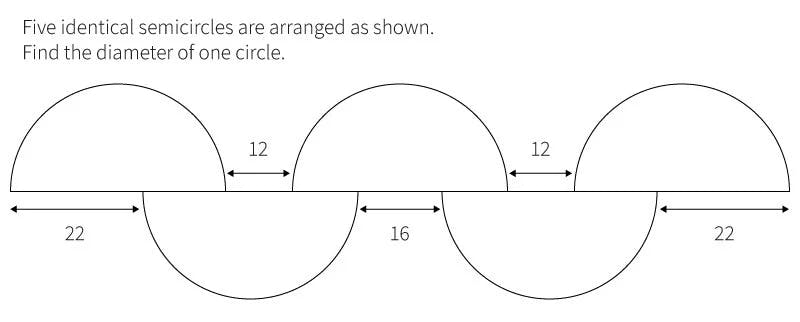
These are the hardest questions. Even if you know all the tricks and concepts, they're still tough to solve. Many of these are shapes questions or problems that need you to think in creative ways. In my opinion, the best way to solve these hard questions is to use algebra or simultaneous equations. Here is an example of a level 5 question:
How This Rating System Helps You
Knowing these levels can help you:
- Practice the right questions for your level
- Build confidence by starting with easier questions before moving to harder ones
- Set goals that make sense for you
- Find out what you need to work on when you get stuck
Remember, everyone learns at their own speed. You don't need to master Level 5 questions right away. Just keep practicing and learning, and you'll get better over time!