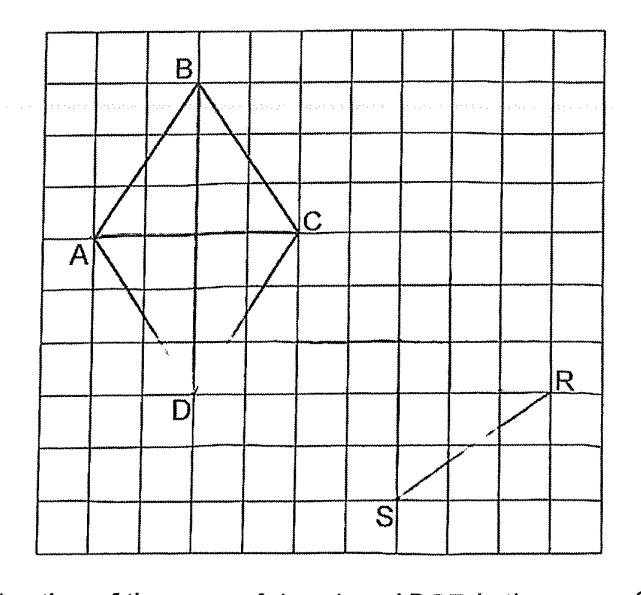
Independent solution, checked against the source drawing. RS moves 3 squares right and 2 squares up from S. To make a right angle, use a side that moves 2 squares left and 3 squares up. Apply that same move to S to locate P and to R to locate Q, then join the four vertices. The sides are equal because the horizontal and vertical displacements are the same pair of lengths, merely interchanged. The neighbouring sides are perpendicular. Each rhombus side also spans 2 squares horizontally and 3 vertically, so the square and rhombus have equal side lengths and hence equal perimeters. Check the labels and right angles in the actual drawing; there is no unique numeric answer.
Question 24a
Video explanation ↓A rhombus ABCD is on a square grid. Using the line RS, draw a square PQRS such that it has the same perimeter as ABCD.