Independent solution. Fold along the joined edges, treating one square as the base. In option 2 the six squares become the bottom, four side faces and top, with no overlap. A face-by-face folding check gives six different face positions. In options 1, 3 and 4 two squares fold into the same face position, leaving a face uncovered. Therefore only option 2 forms the cube.
Question 4
Video explanation ↓The figure below shows a cube. Which of the following is a net of the cube? (1 mark)
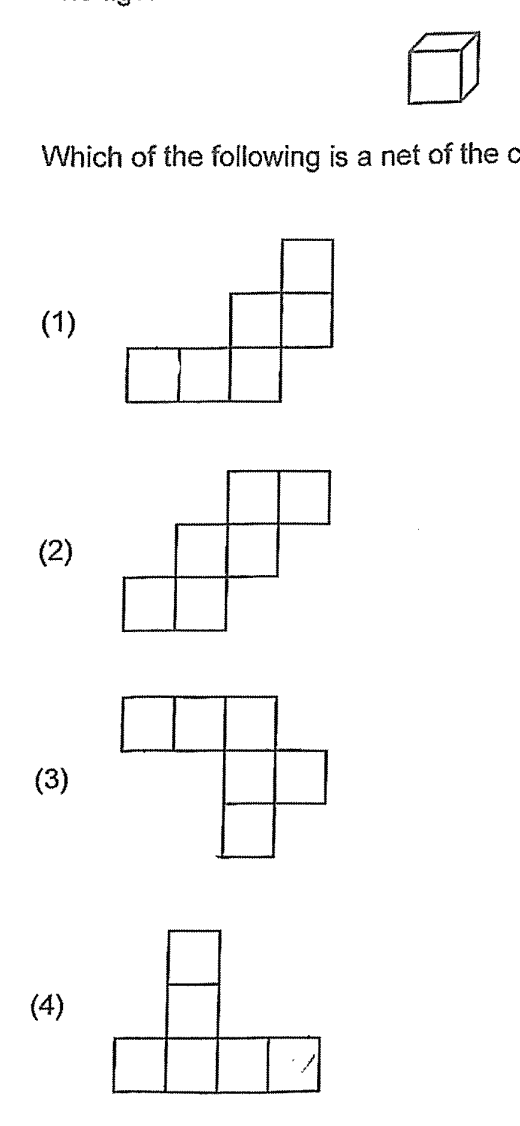
Answer: 2