We analysed 11 PSLE Math Paper 2 (2013 - 2024), and here is what we found
 By Haris Samingan
Disclaimer: Ratings and analysis are subject to changes in the future. Provided for informational purposes only; EzWin Academy makes no warranties and assumes no liability for reliance. This analysis is just for fun!
We wanted to analyse PSLE Math Paper 2 because that’s where many students find it hardest to score well. Here is what we found:
Top 10 Topics
Based on our analysis, here are the top 10 topics that appear most frequently in PSLE Math Paper 2:
- Tables, Line Graphs and Pie Charts
- Percentage
- Rate
- Algebra
- Special Quadrilaterals
- Ratio
- Area and Circumference of Circle
- Volume of Cube and Cuboid
- Average of a Set of Data
- Area and Perimeter
Top 10 Concepts and Heuristics
These advanced problem-solving strategies appear most frequently in challenging questions. Click on the following concept to understand how to solve these challenging questions:
- Simultaneous Equations / Units and Parts Concept
- Grouping
- Repeating Pattern
- Remainder Concept
- Equal Fractions Concept
- Number x Value Concept
- Gaps & Intervals
- Fractions to Units Concept
- Assumption
- Adding Pattern
Paper 2 Difficulty Over The Years
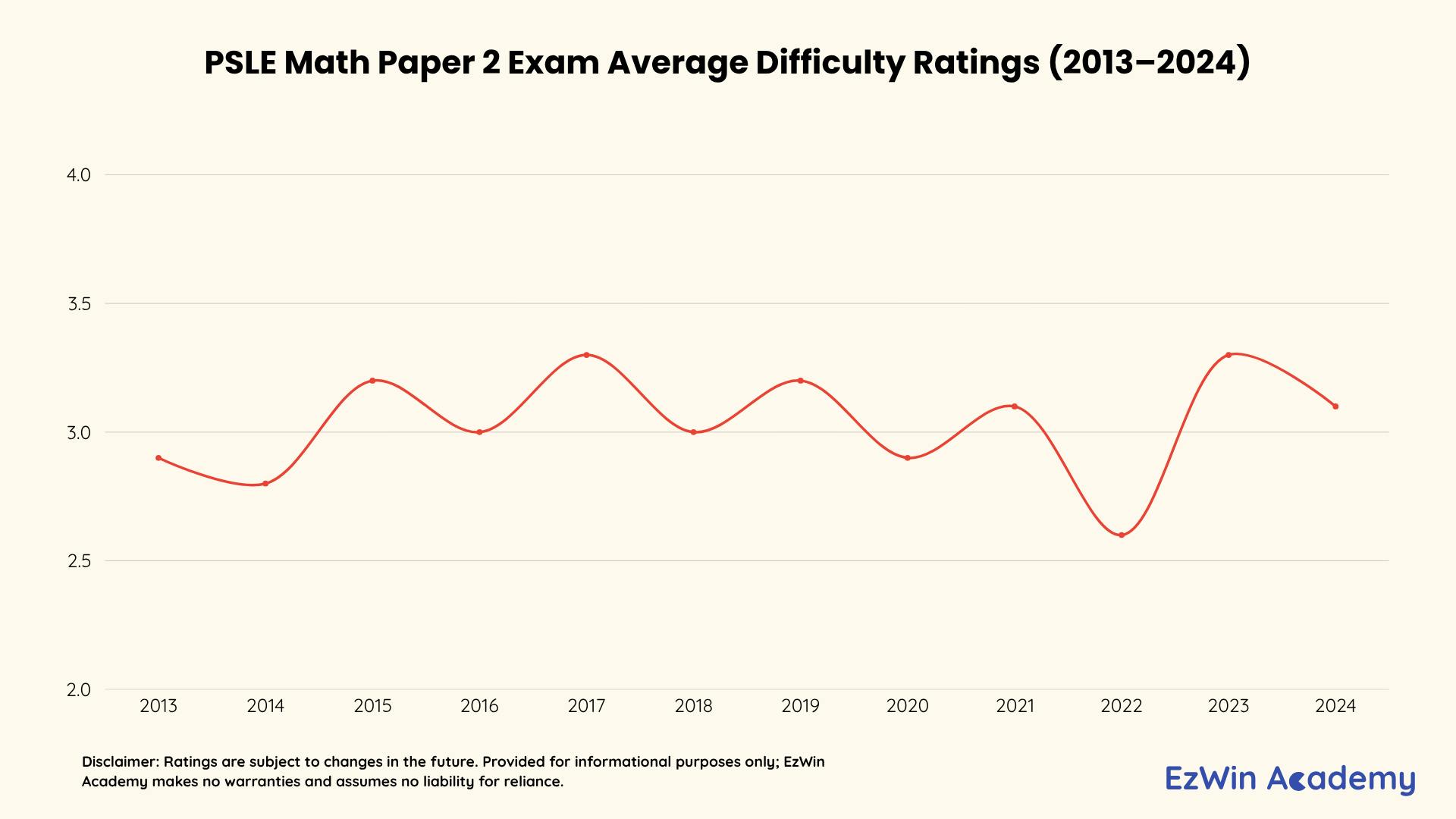
Most papers have a difficulty rating of around 3 out of 5. This means they are not too easy and not too hard. How do we rate each individual PSLE paper? Basically, we rate each question in the paper (from 1 to 5), and get the average score. Here is a full explanation of how we rate math exam questions.
Some papers were easier than others. The easiest paper was in 2022 with a rating of 2.6.
The hardest papers were in 2017 and 2023. Both had a rating of 3.3.
Paper 2 Questions Difficulty Breakdown
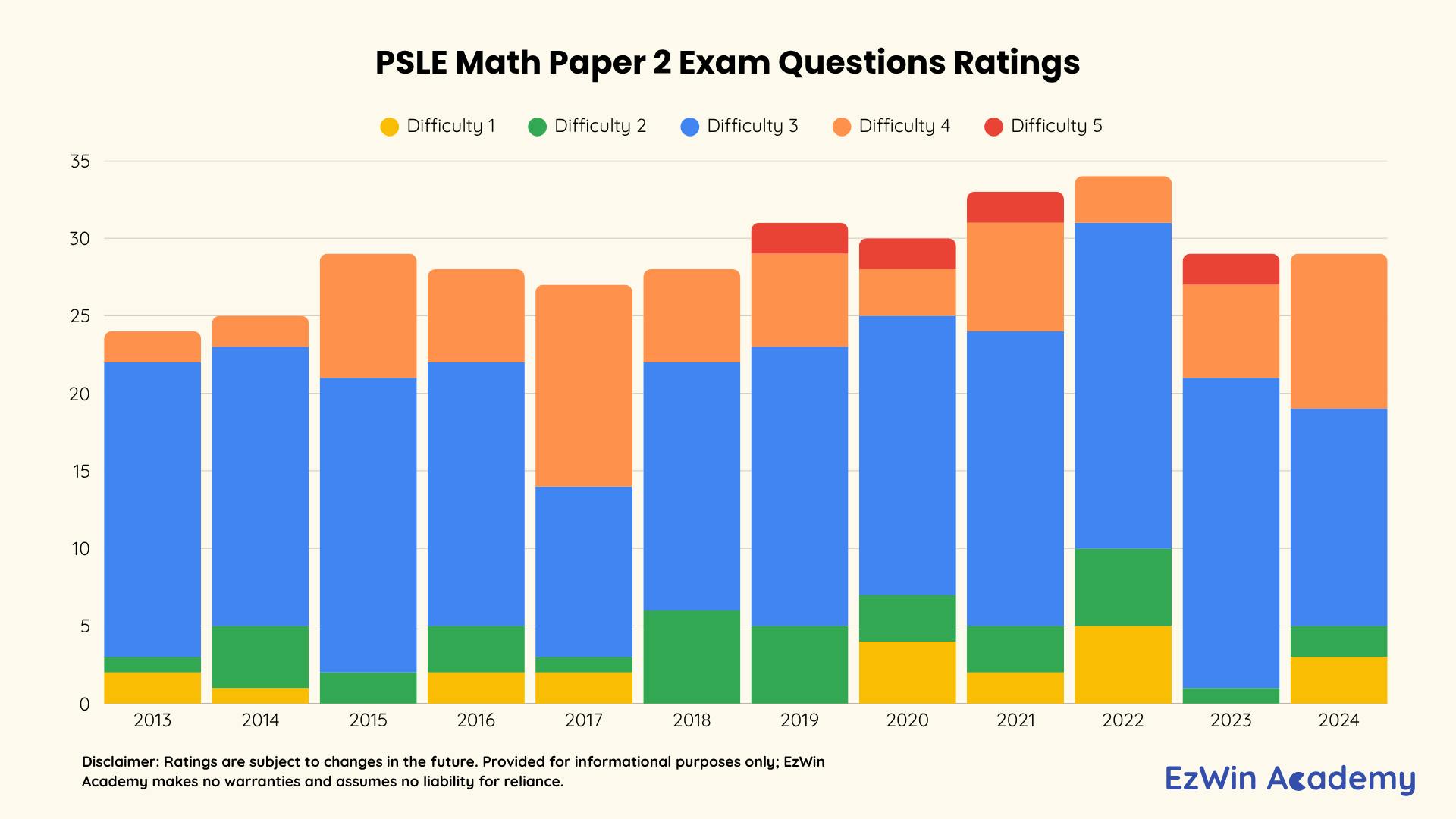
Here is a summarised version of how we rate each math question:
- Level 1: 1 or 2 workings, but it's just calculate or convert.
- Level 2: Some workings involved, but very straight forward.
- Level 3: Standard multi‑step workings, need some time to think on how to solve.
- Level 4: Heuristics or deeper concepts (e.g., before‑after, working backwards).
- Level 5: Very challenging.
Here is a full breakdown of how we rate math exam questions. Let's look at some interesting finds of the PSLE math exam questions:
Most questions are Difficulty 3 (medium difficulty). Every paper has about 11 to 21 questions at this level. If you can answer these questions well, you will do well in the exam.
Difficulty 4 questions are becoming more common. In 2013 and 2014, papers only had 2 to 3 really hard questions. Now, papers have 6 to 13 hard questions. In 2017, there were 13 Difficulty 4 questions! This means students need to think harder now.
Difficulty 1 questions (the easiest ones) are very rare. Some years have zero easy questions! When they appear, there are usually only 2 to 5 questions. So don't expect many simple questions in the exam.
Difficulty 5 questions (the hardest ones) are very rare too. They only started appearing in 2019. When they show up, there are only 2 questions. These questions are very challenging.
Difficulty 2 questions are in between. Papers usually have 1 to 6 of these questions.
Conclusion
This analysis looks at past papers, not a guide for what to study next. Don’t use it to pick only certain topics. Always practise all topics and concepts to have the best chance of scoring well. Patterns can help you be aware, but we can’t predict the future. Strong basics and steady practice matter most.